
This skincare reseller posted their "perfect" Google Ads performance on Reddit. 960% ROAS, profitable campaigns... so why can't they scale?
I'm about to show you exactly what's going wrong - and it's not what you think.
“I’m a small skincare retailer… feels like I’ve peaked my Google Ads performance…”
I see this exact situation constantly on Reddit — and most people miss what’s actually going on. The comments were all over the place - "switch to Facebook," "increase your bids," "try YouTube ads." None of them caught the real issues.
Today I’m breaking down this Reddit post from a skincare reseller who thinks they’ve maxed out Google Ads and are considering jumping to Meta. But the real problem isn’t the platform — it’s two hidden bottlenecks quietly capping their growth.
And once you understand these bottlenecks, you can fix them — whether you’re a reseller or a single-brand store, spending $20/day or $20,000/day.
Alright, let me walk you through exactly what this retailer shared and why it immediately caught my attention.
First, the business setup: They're a small skincare retailer, but they're a reseller - meaning they don't own the brands, they just sell other people's products.
They focus on one specific brand that gives them the most revenue, and they've been optimizing it the longest.
Here's their campaign structure: Two campaigns.
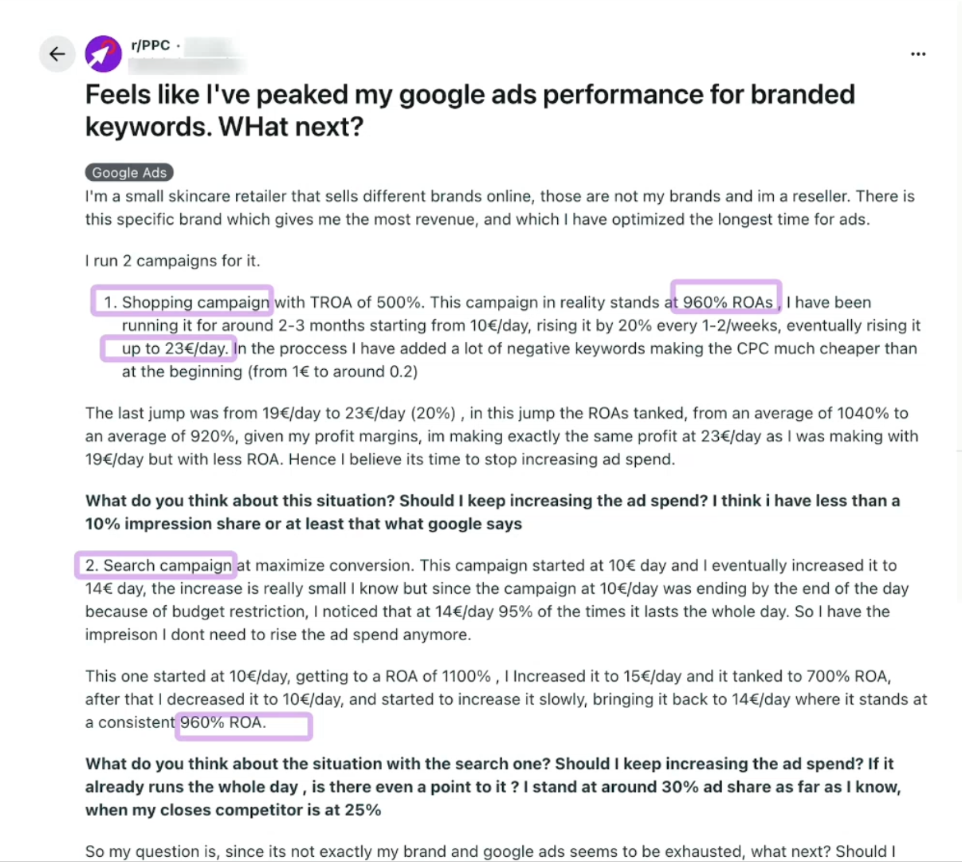
Campaign one: Shopping campaign with a 960% actual ROAS. They're spending up to 23 euros per day. They started at 10 euros and slowly scaled up over 2-3 months, increasing by 20% every week or two.
Campaign two: Search campaign spending 14 euros per day. Also hitting 960% ROAS consistently.
Now, 960% ROAS sounds incredible, right? Most advertisers would kill for those numbers.
But here's where it gets interesting - and where the problems start to show.
When they tried to scale the shopping campaign from 19 euros to 23 euros per day - just a 20% increase - the ROAS tanked from 1040% down to 920%. They're making exactly the same revenue at the higher spend, just with worse efficiency.
The search campaign? They say it runs for 95% of the day at 14 euros, but when they tried 15 euros, performance collapsed, so they scaled back.
Here's the red flag that most people missed: Less than 10% impression share on shopping. Think about that for a second. They have amazing performance, but Google is barely showing their ads at all.
" I think i have a less than a 10% Impression Share"
When you have incredible ROAS with tiny impression share, you don't have a scaling problem - you have a data problem. Google doesn't understand your products well enough to show them beyond the most obvious, high-intent searches.
This is the classic scaling plateau pattern I see everywhere.
Here's the first problem I spotted immediately: they've essentially turned their campaigns into brand-only advertising.
The retailer mentioned that they "added a lot of negative keywords" which made their CPC cheaper - from 1 euro down to around 0.20 cents. This sounds like great optimization, right?
Wrong. This is classic over-optimization.
When you aggressively add negative keywords to improve efficiency, you're essentially building walls around your campaigns. You get great ROAS because you're only showing for the most obvious, high-intent searches - usually branded searches.
Think about it: if you're a reseller and you add negatives to block anything that's not perfectly relevant, you end up only capturing people who already know the specific brand and product they want.
This creates what I call the "brand-only prison." Your campaigns become incredibly efficient at capturing existing brand awareness, but they can't expand beyond that. You're basically paying Google to show ads to people who were probably going to find you anyway.
This explains the high ROAS but under 10% impression share. They're capturing their slice of existing brand searches, but Google can't find new customers because the campaign constraints are too tight.
Here's what most people don't understand: to scale, you need some "messy" traffic. You need searches that convert at lower rates but open up new customer segments.
Growth = Efficiency + Discovery
When you optimize purely for efficiency, you kill growth potential. It's the classic trade-off between discovery and efficiency.
The fix isn't to remove all negative keywords at once - that would be chaos. You need to strategically audit your negative keyword lists and test removing broad category blocks that might be eliminating good traffic.
Start with the most restrictive negatives and test in small phases while monitoring performance closely.
But even if you fix the negative keyword problem, there's a second bottleneck that most advertisers completely ignore.
The retailer said their feed "seems fine" - it has high-quality images, descriptions, and product identifiers. But here's the thing: that's just the baseline. That's what everyone has.
When your product feed only has the basic required fields - title, price, image, description - you're asking Google to be a mind reader. Google has milliseconds to decide which products to show for each search, and it's making those decisions based on very limited data.
Think about what happens in the auction. Someone searches for "anti-aging serum for sensitive skin." Google looks at your feed and sees "Retinol Serum 30ml" with a generic description. Then it looks at a competitor who has enhanced their feed with specific attributes like gender: "women," and a benefit-driven title like "Gentle Anti-Aging Retinol Serum for Sensitive Skin."
Who do you think gets shown?
The solution is strategic feed enhancement. This means three levels of optimization:
Level one: Front-load your product titles with benefits, not features. Instead of "Retinol Serum 30ml," use "Anti-Aging Retinol Serum for Sensitive Skin - Dermatologist Recommended."
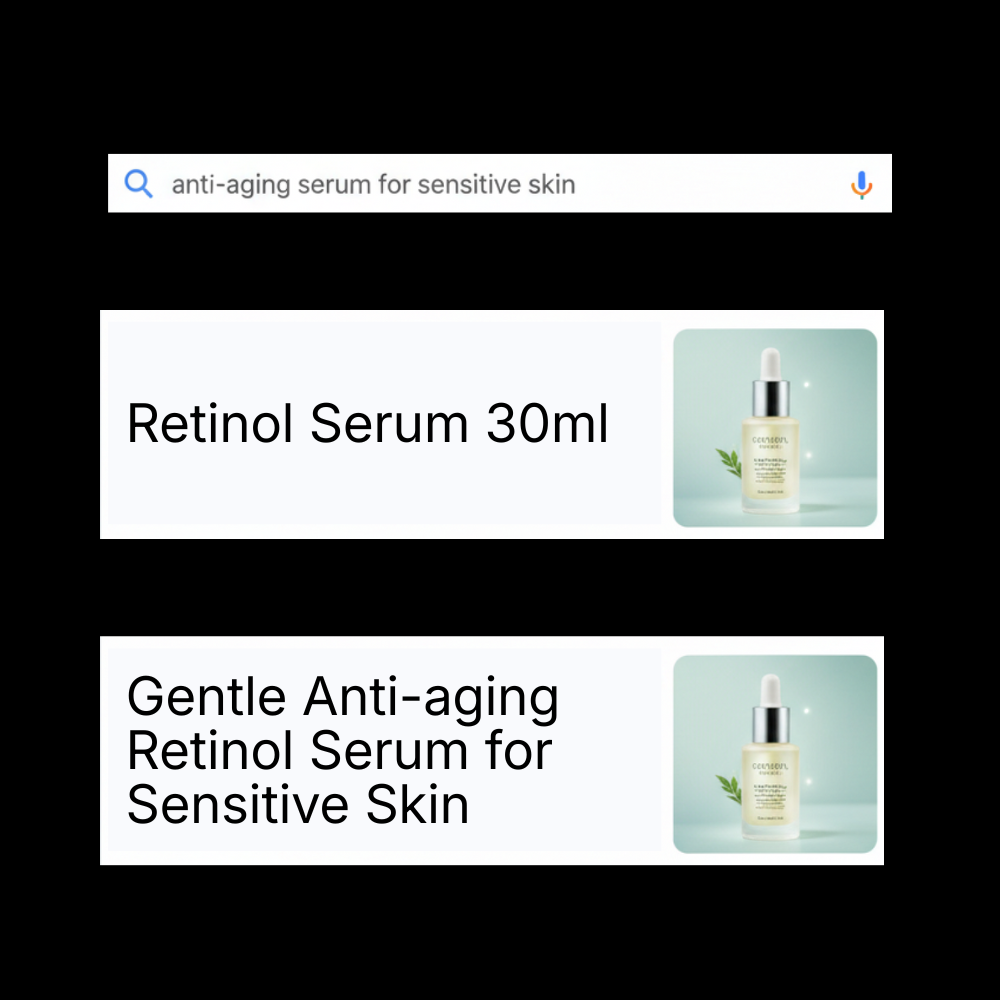
Level two: Rewrite descriptions to focus on what the product does and who it's for, not just what's in it. Instead of "Contains 2% retinol," use "Reduces fine lines and dark spots for sensitive skin. Visible results in 4 weeks."
Level three: Fill out the optional relevant attributes that most competitors skip. Size, material, age group, gender. And make your product type descriptive and keyword-rich.
But here's an important optional attribute most people overlook: the product type attribute.
First, actually create it — and use it. It not only gives you another way to structure your Shopping campaigns, but it also signals to Google how you think about your products.
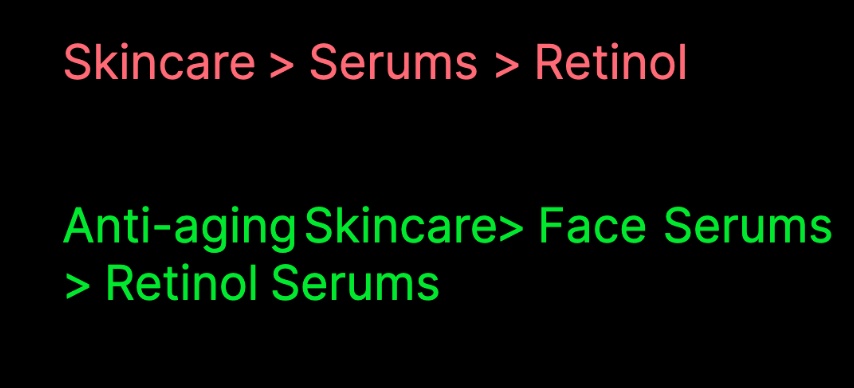
Second, don't settle for basic labels like "Skincare > Serums > Retinol."
Make it keyword-rich and meaningful:
Instead of: "Skincare > Serums > Retinol"
Use: "Anti-Aging Skincare > Face Serums > Retinol Serums for Fine Lines."
Here's the kicker - most of your competitors aren't doing this.
Most of your competition isn't doing this!
They're using manufacturer descriptions, basic titles, and no or minimal optional attributes. When you optimize your feed strategically, you're not just improving your campaigns - you're gaining a massive competitive advantage in every auction.
So back to the original Reddit question: "What's Next and Should I just jump to Meta ads?"
The problem isn't the platform. Google Ads wasn't "getting more expensive" or "exhausted." The problem was treating optimization like a game of restriction instead of expansion.
This retailer had two fundamental bottlenecks: over-optimized negative keywords that created a brand-only prison, and a basic product feed that limited auction opportunities.
Fix these two things, and they will start scaling.
Here's your homework this week: Audit your shopping feed. Look at your product titles, descriptions, and type attributes - are they keyword-rich or generic? Check your optional attributes - size, color, material. If Google's algorithm saw this data, would it know exactly who needs your products and why they're better than the competition?
If not, you've found your scaling bottleneck. And the solution has nothing to do with switching platforms.
.png)
.png)


.png)